
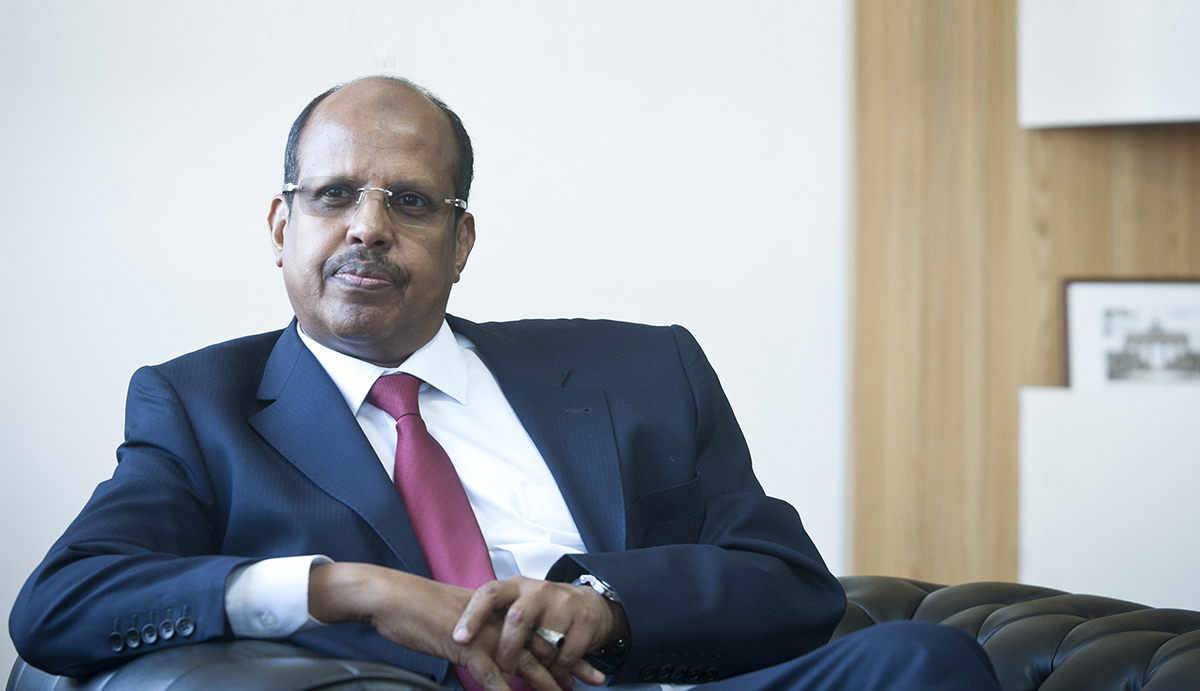
16 Sep Interview with His Excellency Mr. Mahmoud Ali Youssouf, Minister Foreign Affairs and International Cooperation
With its projected 5.1% economic growth for 2024, can you share what some of your priorities are for Djibouti today and how these priorities tie into the National Development Strategy spearheaded by President Guelleh’s Vision 2035?
Djibouti is a small country of 23,000 square kilometers but in a very highly strategic location in the Horn of Africa, over the Gulf of Aden and the Strait of Bab Al-Mandab. We have been living in a quite troubled region for many decades. We had to deal with the Somali crisis for many years and now Sudan is collapsing into a civil war. You also have to add to that, the attacks of the Houthi on vessels passing through the Strait of Bab Al-Mandab.
As the government of this country, we have been very cautious in maintaining that stability. We host a lot of foreign forces and NATO forces, to create these conducive conditions for maritime safety. We are also contributing with our troops as part of the African Union forces to provide security to Somalia. We have been very active in the Sudanese crisis too. Djibouti is the Chair of the Intergovernmental Authority on Development (IGAD). Our role as a small country without any hidden agenda, without any ideological approaches, is trying to be friends with everyone in the region and trying to have partners everywhere in the world, without making any distinction between them. The only goals we are pursuing in our foreign and internal policy are peace, stability and safety. We are trying to maintain that equilibrium, that balance, to survive in a very troubled region.
We have so many hindrances when it comes to development but we managed to capitalize on all our comparative advantages. We have developed a very good logistic infrastructure, we opened a very dynamic corridor with the neighboring countries; we built several infrastructures with Ethiopia, which is a big market of almost 130 million people. We are also targeting regions like the Eastern part of South Sudan and the Ugandan market. Normally, a small country could face challenges but we manage to overcome those challenges by creating that sense of safety and security to attract investment in this country. We have a very liberal economy, we have a quite parity currency with the US dollar, so a very performant financial system that enables us to attract investors in this country.
Our development plan over the coming years follows our previous five-year plans which have been implemented such as SCAPE, which was aimed at creating employment for youth in this country and we had another second five-year plan called ICI — Inclusivity, Connectivity and Interactions. Today, we are talking about the next generation of economic development plans. One of the main objectives that we have is developing our digital sector. We think that the digital economy is a growing sector of modern economies and we have some comparative advantages. We are the landing port for almost 13 major submarine cables, fiber optic cables, coming from southeastern Asia, going through the Strait of Bab Al-Mandab and the Suez Canal to Europe. We have a huge capacity in terms of digital capacity. We provide internet services to Ethiopia and even beyond.
How would you characterize Djibouti’s role in the region in terms of peace and security and what was the outcome of your meetings in May 2024 with the US Special Envoy for the Horn of Africa?
Djibouti and the United States undertake a strategic relationship. After the 9/11 terrorist attacks in New York, the United States was looking for a foothold in this part of the world to fight terrorism. All the African nations at that time were not very comfortable with this American presence. But Djibouti understood that terrorism is a threat to all of us and that if we do not contribute to the fight against terrorists, no country will be safe, either in the United States or in this part of the world. Djibouti, in the very beginning, decided to host the American forces and to provide them with all kinds of facilities so that they could carry out their mission in terms of making the region safer, the Strait of Bab Al-Mandab and the whole world at large. It was a very successful relationship and it has continued since then. We always have new threats emerging, like the attacks on the vessels in the Strait of Bab Al-Mandab by the Houthi group, the Al-Shabaab terrorist groups in Somalia and all kinds of other threats to our collective and global safety and security. It was quite natural that Djibouti decided to continue to be a faithful partner to all those countries who contribute to peace, security and stability in the world.
My discussions and my interaction with Mike Hammer, the Special Envoy have been always on a steady, very friendly basis. We always exchange views and consult on several issues, because Djibouti recognizes the critical role of the United States in this region. As a superpower, the United States has a specific and special responsibility in trying to help countries in the region face terrorism and fight against piracy and all kinds of other threats to their safety and security.
Between Djibouti and the United States, we have a forum of discussions and consultations called the BNF, which is the Bi-National Forum. Once a year, we have meetings, either in Washington or in Djibouti and we have global discussions on so many issues. We are proud of having that kind of relationship with the United States. We also have a relationship with the European Union. Although small, Djibouti is a very positive, dynamic and very active contributor to peace and security in the region.
Can you give our readers an overview of the different investment opportunities becoming available in the near and medium term and why it makes business sense for US firms and investors to participate in the nation’s economic transformation?
The energy sector, because the energy sector was, for many years, one of the bottlenecks for our economy. We decided to develop renewable energies so that we can reach our 100% consumption of green energy and we’re working on that. We have already succeeded in importing hydropower from Ethiopia, we have built 60 megawatts of wind power. Now we are developing solar power with several investors, mainly the Emiratis and Saudis. We are also working on a project of tidal energy. Some of them are completed, others are really on the way to completion.
An investor needs to have a very safe environment with cheap energy and a very flexible and performing financial sector and we have these ingredients. If it is not complete, we are working on it. American investors can be interested in Djibouti because we have these characteristics, we have world-class ports, we have an electric railway between Djibouti and Ethiopia and fiber optic submarine cables. We are also in the vicinity of bigger markets. We are at the crossroads of the most frequented maritime route. Business is, first and foremost, a question of opportunity. With the comparative advantages and the proximity of big markets, it’s very advantageous and profitable for investors to come to Djibouti. We don’t suffer from the fluctuation of our currency, we have a very flexible financial system. If today you decide to invest $1 million, for instance, you can withdraw that money anytime; there is no constraint on the movement of capital, so money can go out of Djibouti anytime.
Those are the kind of facilities, the kind of conducive environment we have been working on for the past two decades so that Djibouti’s market becomes the most attractive in the region. If you compare it with the neighboring countries, you will see that we have a long distance in terms of advantages and we are ahead of all the markets in the region. That’s why my message is to say: Come to Djibouti, you will see all kinds of facilities and advantages we provide to investors.
How would you describe the relationship of Djibouti with the US currently and how are you working from the ministry to strengthen these bilateral relations?
We have a strategic partnership working together on security issues. We have the Binational forum once a year. I am in contact with all the high officials of the State Department, starting with the Secretary of State Antony Blinken, with Mike Hammer and Victoria Nuland; all the people in the State Department are good friends and I have regular contact with them. I think that the United States soon understood the role of Djibouti in the region. That’s why they have their military forces present here. They also understood the role of Djibouti at the head of IGAD and the way we are trying to contribute to peace in Somalia and Sudan. We are always consulting our friends and partners to seek the best ways and means to restore peace and stability in this region.
I can describe Djibouti and the United States relationship as strategic, very friendly and very proactive and dynamic. We need to see more of the United States’ involvement in this part of the world when it comes to the economic side. Security-wise, they are present and they are doing their best, but economic-wise, we need to see more investment and more American companies come and invest in this part of the continent.
What would be the final message from your ministry from you, as the Minister of Foreign Affairs, to these readers, not only in the US but also worldwide?
For international observers and those who follow what is going on as a general trend, whether we see the polarization of the world, you see that focus is now made on very critical, sensitive and strategic places because the positioning of major actors in very sensitive places is very important. When you look at Djibouti’s geographic and strategic location, we are very close to the oil reserves in the Arab Peninsula, we are at the gate of a growing market, the African continent; and it will be one of the drivers of global growth.
The Horn of Africa has 400 million consumers. When you look at this map, you look at the strategic configuration of the world and you have that clear idea of the tendency and the trend of the world that is heading to polarization, you have to be convinced that this is the place to be. This is the place to be for future businesses, this is the place to be for growing economies and global growth, this is the place to be to protect one’s trade because you have to keep in mind that 40% of the European trade with South-East Asian countries and 20% of global trade go through the Strait of Bab Al-Mandab. If you are not present here, you will miss the train. That’s why all eyes are on Djibouti. So, I’m saying to our American friends and all you readers, come to Djibouti!
Sorry, the comment form is closed at this time.