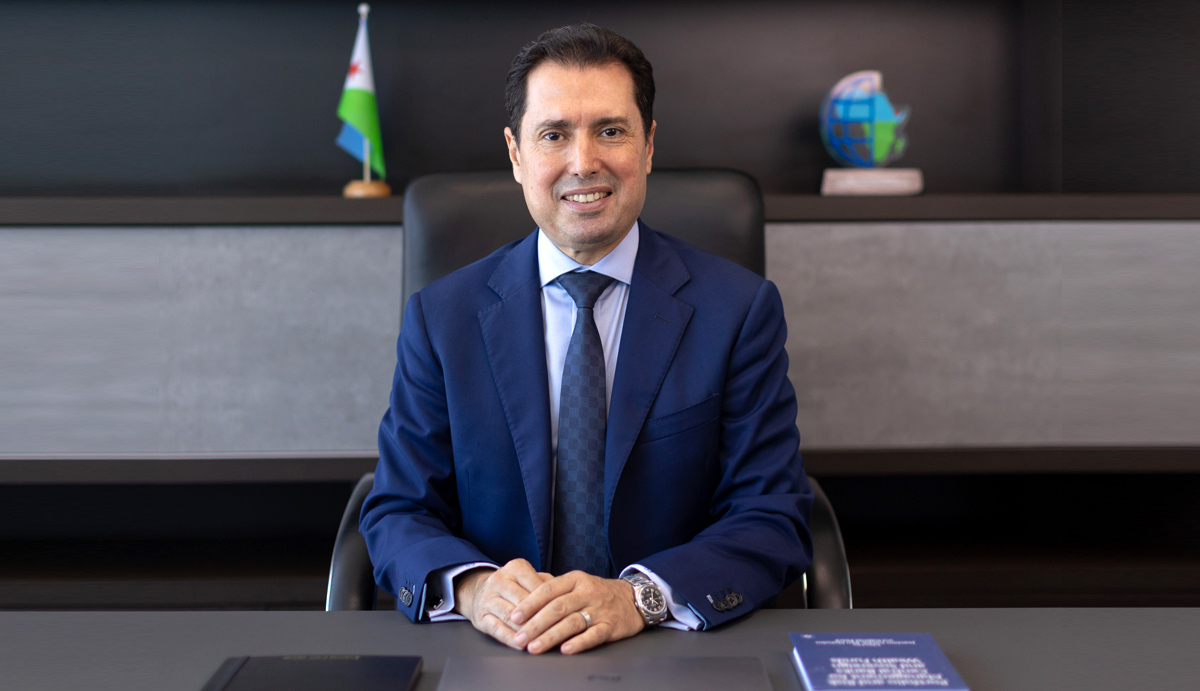
16 Sep Interview with Slim Feriani, CEO, Djibouti Sovereign Fund (FSD)
Can you give us an overview of the reasons for Djibouti Sovereign Fund’s (FSD’s) establishment and its current mission?
We launched FSD in 2020, which is not a long time ago compared with other sovereign wealth funds in Asia and the Middle East. We are one of around 70 or so countries in the world that have sovereign wealth funds, which is about one third of the nations around the world. There are currently no financial markets in Djibouti such as stock markets, bond markets, hedge funds or a private equity industry. The financial services sector consists of only a dozen commercial banks. We are a new player and play a large role in developing the sector. Our priority is to invest directly in private equity or venture capital along with strategic partners. We are a bit different from other sovereign wealth funds as we are focused on greenfield investments. We consider ourselves pioneers. On the one hand, it is exciting, but on the other it requires a lot of patience. With developing countries such as those found in Africa, everyone believes there is a magic wand and tomorrow everything will become something like Singapore. Managing expectations is a huge challenge. One cannot do things in a year or even in three years’ time. The normal horizon before seeing significant change is five to ten years.
FSD is inspired by and follows the trajectory of Singapore’ sovereign wealth fund Temasek Holdings, which was created 50 years ago. The local law set up in 2020 has assigned us with resources similar to the ones assigned to Temasek, which was seeded with state-owned enterprises. For example, we are 100% owners of Djibouti Telecom. We also own 40% of Great Horn Investment Holding, a state-owned holding company that operates 27 companies and owns all deep seaports and free zones in Djibouti. A third state-owned enterprise, Electricity of Djibouti, is in the process of being transferred to us but first needs to change its status from an unlimited company.
All state-owned enterprises pay annual dividends to FSD, which provides us with stable financial resources. The law also allows us to receive 20% of the annual rent or revenues paid by military bases. Djibouti is very well known as a military base hub in this part of the world. We are home to the largest US military base, the only Chinese military base outside of China and the largest French military base in Africa. Japan, Germany, Italy and Spain also have a military presence in Djibouti. This large commitment of military spending sends a strong message from our president and the government of FSD’s ambitions. Finally, the law also appoints FSD with management of 60% of the National Social Security Fund’s assets due to our investment knowhow.
The fund’s portfolio consists of a mix of projects, primarily impact-driven, with a financial or commercial objective. While our co-investors and partners are charities, we are not. Our role is to make an impact and generate savings for the country and for future generations. We prioritize sectors such as renewable energy, financial technology, tourism, mining, infrastructure, technology, industry, real estate, healthcare, education and transport. We offer a solution to the financing gap that is holding back the growth of Djiboutian small and medium-sized enterprises (SMEs) and are the first of our kind in this local segment. We need to make sure these entities are thriving to drive the economy forward. Our mandate is to invest in all asset classes, including sovereign, corporate and private debt. Private debt is the fastest growing asset class in the world. We are focused on industries that employ many people such as tourism, the largest employer in the world.
Beyond diversifying the economy, our second objective is to improve transparency and governance at all levels, starting with ourselves. Good governance is extremely important for emerging developing countries. We are now a member of the International Forum of Sovereign Wealth Funds and are aligned with the Santiago principles of good governance for sovereign wealth funds. While we are young, we are dedicated to reaching international best practices concerning the governance of companies in our portfolio, including Djibouti Telecom and Great Horn Investment Holding. While we have yet to disclose our exact numbers in the public domain, this will happen in the future.
FSD consists of only 15 employees, all of which are Djiboutians save the chief information officer and myself. Abu Dhabi Investment Authority, one of the top five sovereign wealth funds valued at more than $1 trillion has around 2,000 employees, of which three quarters are foreign. In our case, the idea was to bring in an international team with an African touch. We want to make sure everyone relates to each other.
What recent milestones has the wealth fund passed?
We began to execute our pipeline in 2023. First, we signed two power purchase agreements in the renewable energy space, including two solar projects. Second, we performed the underwriting of a private debt loan to a local SME. And third, we launched the country’s first crowdfunding company, our 100%-owned fintech called Inclufin. Our crowdfunding platform supports SMEs and startups in fundraising and mobilizing large idle savings. There are a lot of savings in the country, but they are not recycled in the economy; the banking sector is very liquid. There are a dozen banks that are very well managed and well structured. However, savings are generally not invested here and are instead invested overseas. Our crowdfunding platform allows local businesses to tap into these large savings. It is the first building block in creating a sound venture capital industry, which is currently nonexistent in Djibouti. This will also contribute to financial inclusion, which is part of our responsibility.
In 2024, FSD entered into an agreement with Pan African Internet Exchange. It is a Dutch-based company that has become an African powerhouse in data centers. Their key shareholder is Africa50, which is part of the African Development Bank Group. Together we aim to build a $50-million data center with us as co-investors that will leverage Djibouti’s impressive subsea cables. We have had numerous meetings, exchanges and building relationships in the dating and engagement phase with renowned investment entities, such as Pan African Internet Exchange, Neo Themis and Kasada Capital Management. We have also had meetings with Meridiam, which is a world-renowned infrastructure private equity fund. It is important we build trust. We strive to conduct in-depth discussions and seek out quality and trusted partners.
Why is Djibouti considered an attractive market for foreign direct investment?
Djibouti is a hidden gem, especially for those investors whose mandate includes emerging and developing markets. The nation aims to have more than 7% growth of real gross domestic product (GDP), which is roughly 10% nominal GDP growth. In this sense we aim to double our real GDP in the next 10 years or so, which is an appealing proposition for investors. Growth of this size means a large growth of consumption, which is the major reason investors are attracted to Africa. Djibouti covers an area of around 23,000 square kilometers, which is around 33 times the size of Singapore and roughly the same size as Rwanda without reclaiming further land. Around three quarters of the economy comes from services. It is still driven by the public sector, which means there are many opportunities to develop. We need to go from being driven 75% by the public sector to putting the private sector in a more lead role. We have unlimited investment opportunities; the sky’s the limit. Djibouti is open for business, and we do not discriminate. Morocco is one of the top five investors in Djibouti today. South-South economic integration is very important in terms of trade and investment.
Djibouti is a $3.6-billion economy that is rapidly increasing towards $4 billion and hopefully doubling within the next decade. If we allocated only 10% of our current worth to our five-year National Development Plan, that is $360 million. Our current national transformation plan is about heightening inclusion and connectivity and developing our institutions under the Vision 2035 roadmap. We are in a strategic part of the world with many people competing for space. One third of global trade goes through this part of the world, through the Red Sea and through the Suez Canal. What we require is proper management. Luckily our administration has had a good vision of how things would develop for the last 20 years and has made efforts to develop our world-class port and deep seaport infrastructure. We are not a landlocked country, and we need to take advantage of our geographical strengths and become a logistics hub.
Africa has a population of 1.5 billion people and is growing very rapidly at a speed of more than 300 million people every decade. To put that into context, a population roughly the size of the USA grows on the continent every ten years. We have a population of 130 million in Ethiopia and around 400 million people within two or three hours of our borders. We aim to become a hub for all these people in a similar fashion to Singapore in Southeast Asia. We want countries around us to participate in this win-win situation for prosperity and development. Our location is great for trade but also for other factors such as subsea cables. Another advantage is our political stability and our political will. No one likes uncertainty, particularly investors. Djibouti enjoys social and economic stability, which comes in part by the large military presence of world powers.
Additionally, foreign exchange risk is an important element to consider for international investors venturing into foreign countries. The Djibouti franc has had a fixed parity to the US dollar since 1949, the same as currencies in the Gulf region. One can invest in any foreign currency here without any exchange control. We have a highly developed and sophisticated banking sector with a central bank. In developed countries, the two following things are focused on to have greater visibility: investor confidence and consumer confidence. If one or both are shaken such as during the global financial crisis in 2008 and 2009, development becomes extremely difficult. Unlike most currencies in emerging and developing countries in Africa, Djibouti is not subject to regular fluctuations, instability and depreciations. There is no currency risk premium for any dollar investment in Djibouti; money can transfer freely at the same value. Djibouti is a good place to live and to do business with attractive returns and a low level of risk on investments.
What major challenges is the country facing in terms of sustainable development?
Environmental, social and governance issues are important and begin with good governance. We need to make sure that we do the right thing. One of the largest issues the world faces — particularly the developing world in reaching the 17 UN Sustainable Development Goals – is reducing poverty. However, before we can do that, we need to reduce unemployment and provide jobs. Grants and aid are helpful but are not very sustainable. The most sustainable way to provide jobs is through investments. Djibouti is currently at the threshold of this transition. Everyone who comes to Djibouti likes what they see and believes in its future. Additionally, financial capital is nice to have, but much harder to get is human capital. Africa has been suffering for several decades in this area due to brain drain. People want a better life for themselves and their families and go north, which is a loss for Africa. Investment in education is critical for development. We are working on boosting private sector participation in education, whether at the high school or university levels. Education has become not only an issue for the public sector, but the public sector as well. Djibouti also aims to transition to a 100% green economy by 2035, which is not something many countries have reached. We are well on track. We are a relatively small country of around 1 million people, which means we do not need as much energy as larger countries and things can move quickly. We believe we can meet these goals as early as 2030.
How successful was the FSD’s Djibouti Forum this spring?
We have had overwhelming positive and supportive feedback since our first edition of the Djibouti Forum, which was held in May 2024. The forum was the first of its kind and gathered around 400 participants from 54 countries, including all G7 economies, China, Malaysia and Japan. We had 46 distinguished speakers in only two days. We had 280 participating institutions represented by 43% of the top executive management. We had 18 international media groups, including CNBC Television and the Financial Times. Around $2.5 trillion in assets and management were concentrated on at the forum. Marketing and branding are important. The Djibouti Forum contributed to giving the best impressions of Djibouti and closing the gap between perceptions and reality, especially for those who visited the nation for the first time. Hopefully, the event sowed the seeds for future investments and partnerships in Djibouti and Africa. We believe this will become a significant event in the continent in the spring of each year such as the Davis Forum in Europe each January or the Doha Forum in the Gulf region each December. We look forward to the next edition of the Djibouti Forum, which will most likely take place in February 2025 to coincide with annual presence of whale sharks. We intend to offer our international guests a unique mix of business and pleasure.
Sorry, the comment form is closed at this time.