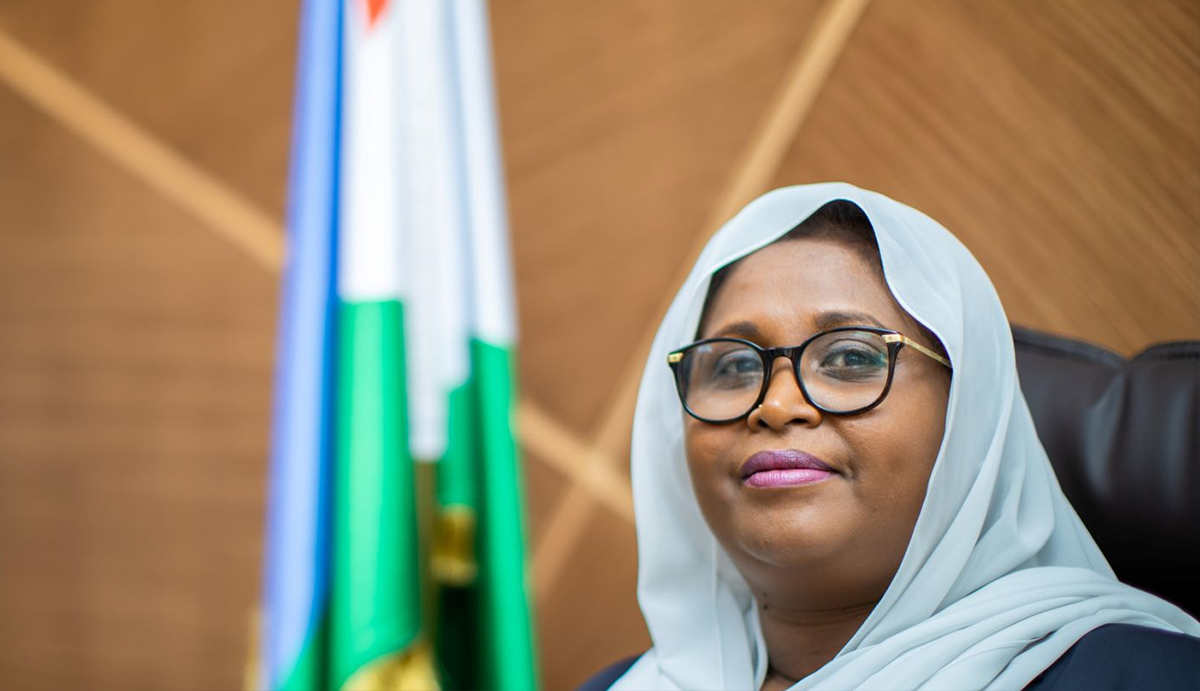
11 Sep Interview with Mariam Hamadou Ali, Minister of Digital Economy and Innovation, Djibouti
What milestones has Djibouti’s passed in terms of the digitization of its economy?
Before the creation of our ministry in 2021, the Republic of Djibouti laid out a roadmap for computerization and digitization of the administration. In the early 2000s when information technology was not yet widespread on the continent, Djibouti already had major programs to connect the administration through the Internet and, for some departments, fiber optics. In some key ministries such as the Ministry of Finance, customs, the public financial expenditure chain and other information systems had already been connected. Before 2000, value-added tax was 33% for equipment in Africa and almost everywhere in the world. At the time, there were not enough laptops and personal computers were expensive; access to computers was a luxury. To support digitization, the government reduced the value-added tax by almost 80% so that equipment could be accessible to the administration and the private sector.
Since then, the state has strategically invested a lot of capital into building subsea cables. We are now the second-largest African country in this segment following Egypt. Djibouti is an arid country with no oil resources. Our tertiary sector, such as services, represents 70% of the economy. To develop the economy, the state has allowed Djibouti Telecom to invest in developing cables, with some projects costing around $60 million. Today we have 10 cables, with plans to increase this number to 12. We are 100% owners of some cables, while others we participate in. We have a Google cable and Facebook also has shares in our infrastructure. In terms of the continent, we are extremely well connected.
Other large countries such as South Africa and Kenya began similar projects but were often unsuccessful. We are proud of our momentum. Djibouti now has a significant information and communications technology industry and are now often on the same playing foot with places such as Dubai, which is much richer than us in terms of connectivity. In terms of the needs of Africa, the continent is now focused on Djibouti. We are now promoting the country in this regard with various institutions such as Smart Africa, the United Nations Economic Commission for Africa and other regional organizations.
What flagship initiatives is the Ministry of Digital Economy and Innovation running to develop Djibouti into a digital hub for Africa, such as its Smart Nation program?
The ministry was created to optimize our digital infrastructure and cables and promote Djibouti as not only a landing site for connectivity but a global digital hub. We want to use our assets as raw materials to attract companies such as Facebook, Google and Amazon to set up shop in our country. We developed a roadmap in 2022. One of the key missions behind the ministry’s Smart Nation program is to boost our contribution to the global digital economy to at least 20% within 20 years. We aim to put the entire administration online within five years or less. While we have sectors that provide some online services, we have not fully digitized all of them. Part of our action plan involves tackling a key sector every year, such as health services, and digitizing it. We want everything involving the digital economy to be linked.
While digitizing the government is important, we also have other priorities. Our motivation is to galvanize the private sector. We are encouraging young IT professionals who are coming out of the administration to come together and develop companies. We are currently emulating the Estonian model, similar to many other countries. We also want to develop a significant e-commerce sector, which is currently growing; we want our e-government initiatives to drive e-business in the country. We also have a smart port project and a smart airport project under the Smart Nation initiative. We aim to transform our logistics transport sector using newer and smarter technologies. Additionally, we are leveraging Djibouti’s membership in the Smart Africa regional organization to propose Djibouti as a continental hub for data centers due to our submarine cables. The two following large companies will soon start activities in this segment: Wingu and Pan African Internet Exchange or PAIX. We are actively inviting other data center companies to join given our competitive advantages such as our built-up infrastructure, energy development and human capital. We plan on signing agreements with 42 schools to develop national skills instead of relying on international expertise. We aim to prepare 150 young workers for their first promotions who will work for major companies when they enter the market.
To sum it up, our Smart Nation program involves the following three parallel operations: setting up e-government services, setting up a digital private sector and developing local digital skillsets. These are linked because one cannot be done without the other. Since we are a small country, it is imperative we take advantage of what technology offers us, including accessibility and transparency. Being connected promotes transparency. African nations are often criticized as having heavy administrations with weak governance. We want to use these services to change the paradigm in all our services, including taxation. For example, if all customers pay online, we earn more revenue and are more transparent. There are also tax losses linked to the traditional formula that the government is aware of, and an e-taxes platform is currently being developed. We are also promoting online payments. In Africa we are very cash dependent. We aim to develop a digital means of payment without having to visit the administration.
What major challenges does Djibouti face in terms of building up its digital penetration, both in the regionally and locally?
We worked together with the World Bank to produce the Digital Economy Diagnostic report for Djibouti that underscores the number of challenges the country must overcome concerning digital penetration. The first challenge has to do with repayments. We invested more than $300 million dollars in our cables by taking loans from banks and investing in this infrastructure with our own funds. We have kept a fairly high rate to allow the operator to repay a part of the debt and the state to repay the other part. However, to do so we require resources that justify rates and accessibility.
The second challenge we face has to do with demand. Djibouti is a small customer compared to Ethiopia and Somalia and it is difficult to keep a monopoly on these two nations. To do so we need to invest in cables and maintain a good rate so that the 120 million subscribers continue to buy internet from Djibouti. Our ambitions are not solely based on providing access to our local market and we have been successful. Ethiopia and Somalia have developed their economies and trade through the provision of the internet through Djibouti. However, we face low penetration in our own country. To create dynamism at the local level, we want to launch a strong new private operator by the end of the year. When the market is a monopoly, there are certain imperfections that exist. We launched a first attempt at opening the market two years ago, however large companies were heavily impacted by the post-COVID period and did not want to enter the market. We have taken this time to organize the company and bring things back in order and are now resuming the opening process. We aim to provide cheap and accessible internet for all locals.
Available affordable energy is also a challenge, particularly in setting up a data center hub. We have a large port sector that is a big consumer of energy, and we need to be careful balancing supply and demand. A decade ago, we began to focus on developing local energy production due to strong demand. While Djibouti does not have oil, we do have other resources such as geothermal and other renewables, although geothermal exploitation is expensive. Today we are appealing to investors to join the market to produce energy. We recently completed a deal with a company and port to develop a wind energy project. We have also started on a solar project with AMEA Power, a company from Abu Dhabi. We are moving in the right direction. Compared to a decade ago, we are now open to authorizing energy production companies to set up developments in the country. In today’s market large companies have also started to build data centers and energy production assets at the same time to produce energy themselves. We are ready to negotiate lower prices for data centers as they consume more energy.
What is Djibouti doing to drive the formation and success of new small and medium-sized enterprises and startups?
The Center for Leadership and Entrepreneurship (CLE) is doing an incredible job having only existed for the last five years. For small and medium-sized enterprises, CLE provides formalization services, financing lines and support at the tax level. They began by strengthening the ecosystem, including working with institutions to work on guarantees such taxes. The tax code currently does not account for these new small businesses. We have brought in a reform at the tax level to allow these small companies to work in the market. We have also signed agreements with different entities such as the tax, registration and credit institutions. We want to create a platform so companies can register or pay taxes online. We have also created a link with the chamber of commerce so that small and medium-sized enterprises can find mentors and be supported by larger companies, including undergoing accounting and software training.
Another flagship action that CLE began two years ago is the Startup Djibouti acceleration program, the first initiative of its kind in the market. The project began quite recently, and at the end of October 2024 we will have the first group of 25 startups that will follow the entire support process, including our training programs. Our new startup leaders are graduates from everywhere that have innovative ideas and want to pursue them. By November we hope to finish the first promotion stage for our startups. Our leadership center is now connected by fiber and includes artificial intelligence programs and Oracle training. We have 1,000 young people trained online at CLE in case they do not have access to the internet at home. Smart Africa also offers training at three levels: administration, politics and youth.
We have also introduced FabLabs, which is aimed at helping entrepreneurs move projects from the idea stage to a functional prototype who may need 3D equipment, robotics and other technologies. We created this space for both young and older entrepreneurs. The first FabLab is completed, the second is in progress and we aim to increase their level of services as we move forward. We have also signed agreements with Saudi Arabia’s The Garage. They have very advanced centers, and we want to emulate these facilities in Djibouti. We also went to Switzerland to work with the different centers and signed a partnership with the government. They have very advanced services, especially in the realm of academics who build startups. We are trying to strengthen the national team by putting them in contact with others who have succeeded. We also will approach France and the USA to develop this further.
How far has Djibouti come in terms of inclusion of women in education and the workforce?
Djibouti has been working on promoting inclusion and support of women for 20 years, including in access to education, healthcare and credit. We want to inspire our women to take on decision making and business. We have been quite successful. There is now equal parity when it comes to girls and boys in Djibouti. Schooling is automatic; a girl is schooled in the same way as a boy. Parents actively encourage girls to go to school. Djibouti is one of the countries where we can congratulate ourselves on attaining these goals. While we are a patriarchal society as a Muslim country, we do nothing without women. Men automatically accept that women work, which is not the case in many African and Muslim countries. The CLE’s executives are balanced in terms of gender. New projects — especially for micro, small and medium-sized enterprises — mainly come from women.
What opportunities are there for US players to develop business partnerships with Djibouti?
The share of digital technology in the American economy is significant, and the Unites States remains the top player in digitization and digital technologies around the world. Given our ambition to use digital technology to generate resources and resolve national and regional challenges, we have a lot to learn from our North American counterparts. We have a defense agreement and a strategic partnership with the United States. They also have a large military presence in Djibouti. We will attempt work with United States Agency for International Development regarding cybersecurity, developing startups and other digital developments, including a program requiring investments of $850 million in both private and public sectors. We are also looking at partnering with entities such as Facebook and Google. We aim to have players such as Amazon come to Djibouti to supply the entire continent. If Amazon does not come, similar players such as Alibaba will come. We are a young continent that wants to use new technologies to solve all problems, including governance, poverty and unemployment. In this we do not see a better partner than the USA. What is required is to set up business links. We have yet to hold a forum with American businesses in Djibouti, and this is something we want to develop together with American institutions.
We have a lot to offer these partners. Africa represents huge opportunities for American investors due to its high level of internet consumption. Today, the continent’s customers represent almost 70% of the globe. Around 60% of Africa’s population are young people who use the internet and all social networks. Additionally, Djibouti offers investment partners flexibility that no other country can offer, including size, accessibility and our open monetary policies that allows transfer of dividends. In Djibouti there is this same level of freedom as is in the United States. I have spoken with the US ambassador about bringing in the largest data center to Djibouti. We are committed to immediately giving the project space for facilities. Our local sovereign fund is interested in helping to set up the partnership. Our geographical position also provides us with key advantages. We are nearby and provide internet to Ethiopia, which has a population of 120 million inhabitants. While Somalia is in conflict, they are also very well connected. Additionally, Djibouti can now provide more than just services to East Africa. With the internet there are no roads or borders in doing business. Everything from art to culture is being done through technology.
Sorry, the comment form is closed at this time.